
Real Edge Network — Revenue Share
Real estate can be like riding a roller coaster. Build income & equity to smooth out the drops.
Most agents who used to only rely on transaction income found they loved the consistency and stability of passive income and benefited from long-term equity — all without having to manage anyone.
The stability question
Most agents build their business on one income stream.
Real gives you three.
Transactions are the core of your business — and they always will be. But adding a second and third income stream means the slow months don't hit as hard, and the good months build something that lasts.
Leg 1
Transactions
This is the core of your business — and it should be. Helping clients buy and sell homes is what you do best. Revenue share doesn't replace this. It adds to it.
Leg 2
Revenue Share
Passive income that grows over time without you managing anyone. Just be a good agent, be helpful, and make thoughtful introductions when Real is a genuine fit. The income compounds while you focus on your clients.
Leg 3
Stock Grants
Stock awards are available for capping, attracting agents, and qualifying Elite program participation. Award amounts, terms, and vesting vary by program. This is one way agents can build long-term equity alongside transaction income.
At most brokerages, you have one income stream and it resets to zero every month. At Real, you can build three — and two of them keep growing even when your transaction pipeline is quiet.
What most agents don't know
Profit share and revenue share are not the same thing
Many agents — especially those coming from KW — assume the models are similar. They're structurally different, and the difference matters more than most people realize.
Paid from office profit
Your profit share check depends on whether your local market center made a profit that month. If the office had high expenses, hired new staff, or had a slow month — your check shrinks or disappears entirely.
You have no visibility into office expenses and no control over management decisions that directly affect your payment.
Paid from company revenue — not from your pocket
Revenue share at Real is paid by the company from its share of agent GCI. You don't pay anything extra. Your split, your cap, your fees — none of that changes. Real funds the revenue share program from the company's portion of commissions.
The formula is transparent: a fixed percentage of each attracted agent's GCI, up to a per-agent annual cap, across five tiers. No office expenses, no hidden variables.
If you've been building profit share at KW for years, this distinction is essential before making any comparison. The models look similar on the surface — they are structurally different underneath.
You're not a recruiter. You're an agent who helps other agents.
Revenue share at Real doesn't require you to manage anyone. There are no teams to run, no offices to staff, no performance reviews to give. You stay focused on your clients and your business — exactly as you do today.
The agents who build meaningful revenue share aren't recruiters. They're agents who wake up every day and think: "I choose to help people today." They notice when a colleague is frustrated with their brokerage. They have an honest conversation when someone asks about Real. They make a thoughtful introduction when it's genuinely a good fit — and they don't push when it's not.
That's it. No scripts, no funnels, no cold outreach. Just being the kind of agent other agents enjoy working with — and being aligned in caring about other realtors' success. When you're at a brokerage that rewards you for helping others succeed, the math takes care of itself.
Revenue share examples on this page are illustrative models, not a promise or guarantee of income. Actual revenue share depends on who you attract, whether they cap, and how their networks grow. All estimates use a consistent model and are not a promise of results. Revenue share is not a promise or guarantee of income. Actual revenue share depends on who you attract, whether they cap, and how their networks grow.
The Model
How Real pays across 5 tiers
Real pays a percentage of each agent's gross commission income (GCI) up to a per-agent annual maximum. The percentages flow through five tiers — each representing agents attracted by the agents above them. This comes from Real's share — not yours.
| Tier | Who | Rate | Max / agent / yr |
|---|---|---|---|
| Tier 1 | Agents you directly attract | 5% | $4,000/yr |
| Tier 2 | Agents your Tier 1 attracts | 4% | $3,200/yr |
| Tier 3 | Agents your Tier 2 attracts | 3% | $2,400/yr |
| Tier 4 | Agents your Tier 3 attracts | 2% | $1,600/yr |
| Tier 5 | Agents your Tier 4 attracts | 1% | $800/yr |
How the tiers work: Tier 1 is the agents you personally introduce to Real. Tier 2 is the agents your Tier 1 agents introduce. Tier 3 is the agents your Tier 2 agents introduce, and so on through Tier 5. Real pays a percentage of each agent's GCI on each tier, up to a per-agent annual maximum.
Revenue share is paid on GCI up to the per-agent annual maximum. Agents must be producing to unlock tiers beyond Tier 1. Revenue share is willable and includes a retirement rule.
What this can look like for different agents
Select a persona to see modeled revenue share growth over 1, 3, and 5 years.
Nice Real Estate
Because people trust you and want to stay connected to you.
Most approachable path. Downstream compounds meaningfully by Year 5.
What's realistic for me?
5 agents over 3 years is one referral conversation every 7 months. You don't need a system — you need a habit.
Social Media
Because you already have an audience and a way to stay visible.
Audience reach accelerates downstream growth.
What's realistic for me?
8 agents over 3 years is roughly one post a week that resonates and one follow-up conversation a month. Consistency beats virality.
Community Builder
Because you bring people together and stay top of mind.
Consistent relationship-building compounds over time.
What's realistic for me?
7 agents over 3 years means one genuine relationship per quarter turns into a conversation about Real. No hard sell required.
Agent Events
Because you create repeated reasons for agents to know and remember you.
Events create the trust that drives downstream referrals.
What's realistic for me?
9 agents over 3 years is roughly 3 events per year where 3 attendees each eventually make a move. Events work because they repeat.
Team Leader
Because agents already look to you for leadership, systems, and direction.
Leadership credibility drives strong downstream networks.
What's realistic for me?
15 agents over 3 years means 5 per year — roughly one per quarter from your existing team or sphere. Your credibility does most of the work.
Expansion / Mega
Because your reach and relationships can grow far beyond one-on-one conversations.
The only bucket that reflects full-network compounding at scale.
What does it take to get to $300K?
Attracting ~50 agents directly over 5 years — roughly 10 per year — and building a network where each of them attracts ~3 more. That's the math behind the Year 5 number. It's a real outcome, not a guarantee.
All estimates use a consistent model: $80K assumed GCI per agent, $2,000 effective annual yield per direct agent after the per-agent cap, plus modeled downstream growth at Year 3 and Year 5. Excludes stock awards, fee savings, and personal production income.
Real examples
These are actual annual revenue share screenshots from Real agents. Contributor counts are approximate. These examples are not a promise of results.
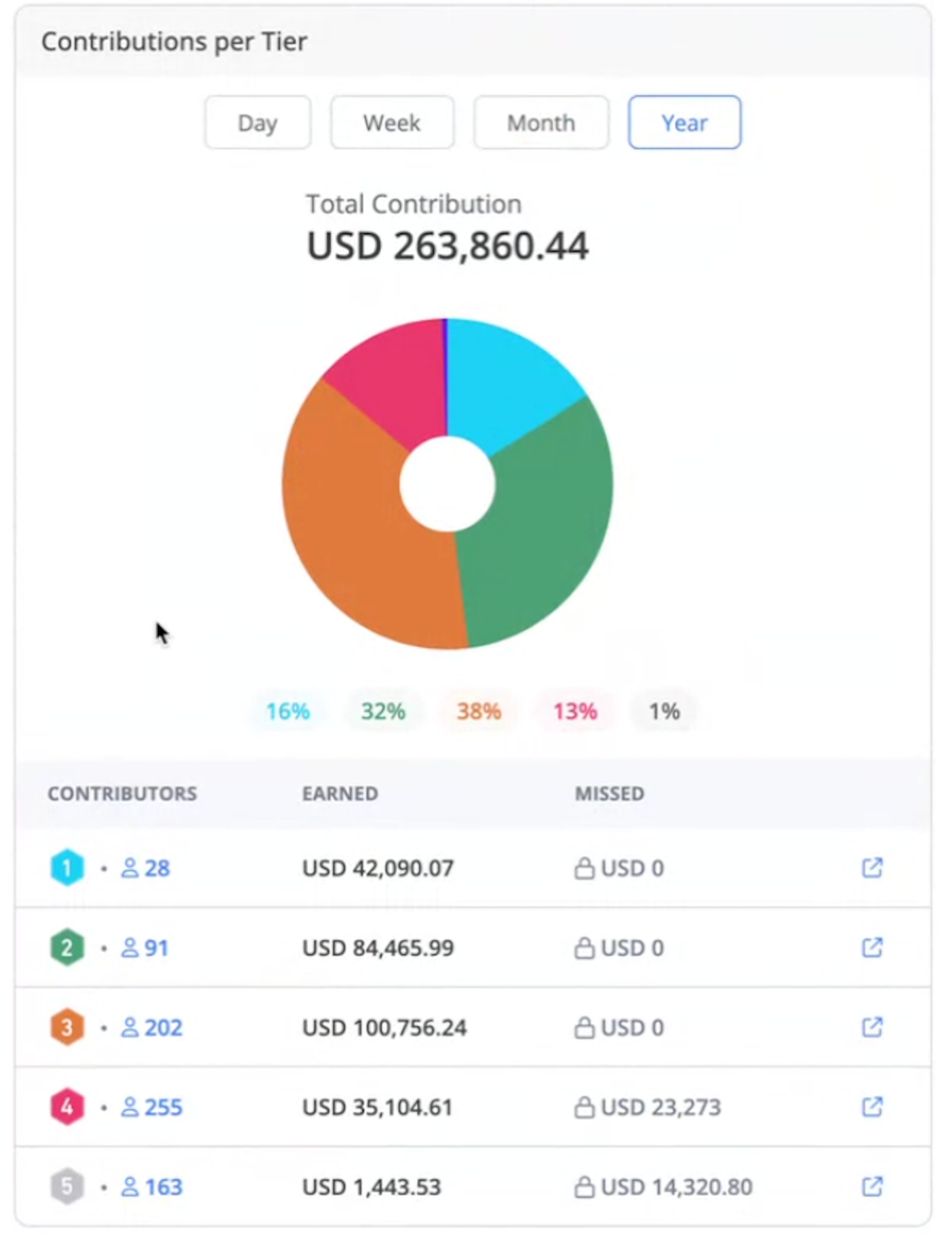
Annual view. Contributor counts approximate. This is not a promise of results — actual revenue share depends on agent production and network growth.
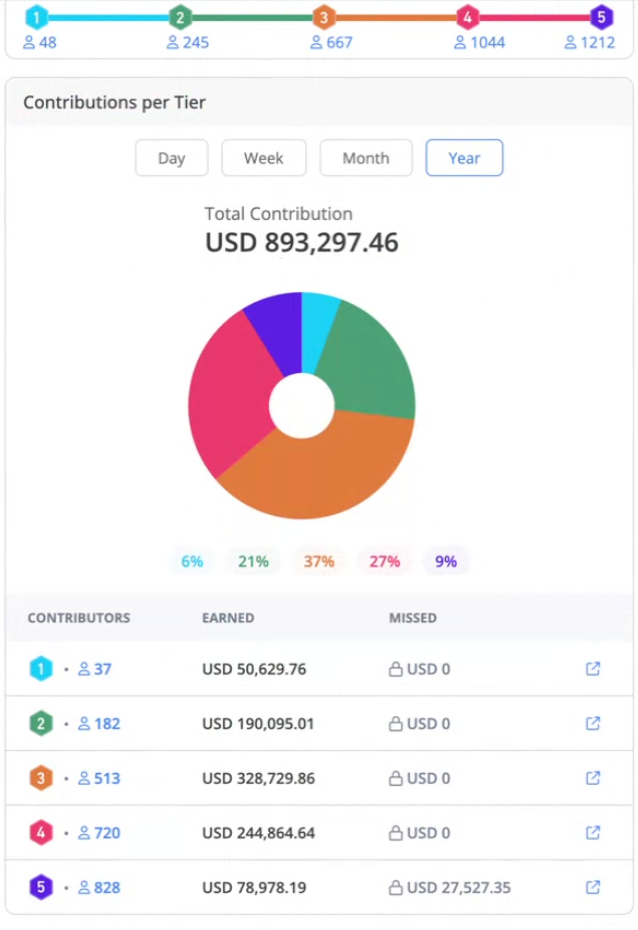
Annual view. Contributor counts approximate. This is not a promise of results — actual revenue share depends on agent production and network growth.
A note on long-term wealth
Revenue share at Real is willable — meaning it can be passed to heirs. There is also a retirement rule that allows agents to continue receiving revenue share after they stop producing, under certain conditions. These are meaningful features for agents who think about their business as something they are building, not just running.
That said, revenue share should not be the primary reason you join Real. The economics, the technology, and the support structure are the foundation. Revenue share is the additional long-term upside — for agents who are already the kind of person others naturally want to follow.
Want to talk through what this could look like for you?
A short conversation is the fastest way to understand the model
We'll walk through the numbers for your specific situation — no pressure, no pitch.
Revenue share and fee savings are two different numbers
Most agents who move to Real save meaningfully on splits, caps, and monthly fees before they attract a single agent. The calculator shows you that number — based on your production level and current brokerage. It is worth understanding both sides of the equation.
Run the numbersHow the examples are modeled
Examples use a consistent model and include direct agents plus modeled downstream growth.
Full methodology and assumptions
Curious about what else comes with joining Real through this network? See what's included with Real Edge Network.
Ready to talk through whether Real is the right fit?
A short conversation is the best way to work through the numbers and see what makes sense for your business.
No pressure. No spam. Just a real conversation about whether this fits your business.